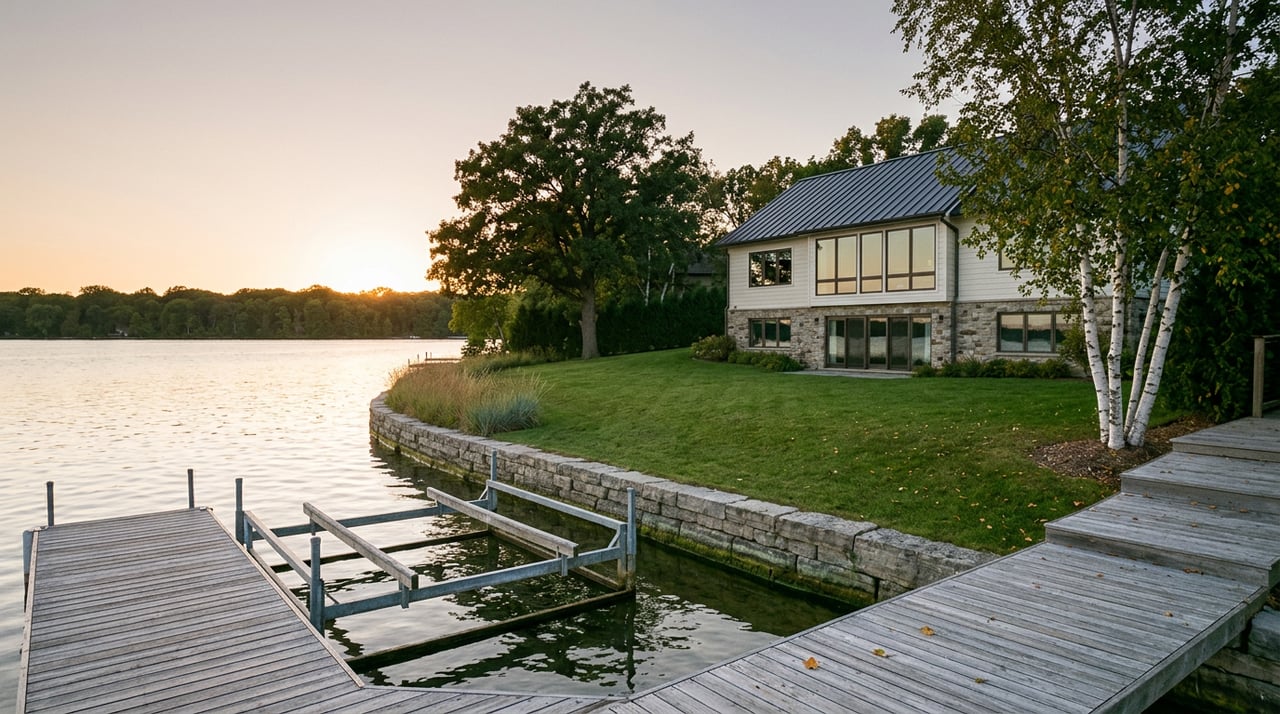
Steve and Sunhi Schussler bought their home in Minnetonka Beach expecting the water in front of it to be theirs to use. What they got instead was a municipal dock angled directly into their frontage, a two-and-a-half-year standoff with the city and the Lake Minnetonka Conservation District, and eventually a lawsuit. The dock hadn't always pointed that way. It had been reconfigured years earlier, after the property next door changed hands and the new owners withdrew a longstanding consent agreement. By the time the Schusslers closed on their own purchase, the dock in front of their new home had already been rearranged by a transaction they had nothing to do with. A Hennepin County judge ultimately sided with the city and the LMCD in 2020, noting that the Schusslers were experienced boat owners who knew about the property's dock issues before they bought it.
That case is the clearest illustration of a pattern that runs through nearly every waterfront transaction on Lake Minnetonka: a change in ownership, yours or your neighbor's, is a legal trigger. It can reset dock configurations, revisit setbacks, and unwind arrangements that felt permanent. What it does not automatically do, at least in Hennepin County, is trigger an inspection of the thing most buyers assume gets checked before closing: the septic system. Buyers coming from counties or states where a septic compliance inspection is a routine part of closing tend to assume the same protection exists here. It usually doesn't.
The Clause Buried in Every Dock Permit
The Lake Minnetonka Conservation District measures shoreline against a fixed reference point, 929.4 feet ordinary high water, and uses that number to calculate how much dock, how many boats, and how much setback a property is entitled to. Every application for a multiple dock license includes a line that most buyers never see because it lives in a permitting document, not a listing sheet. It reads, in the applicant's own certification: if ownership changes, the dock use area must be reconfigured to meet current setbacks.
That single clause is the mechanism behind the Schussler case and behind a category of disputes that recur around the lake. A dock configuration that has existed for decades under an informal or licensed arrangement is not guaranteed to survive a sale. If a neighboring owner who granted an encroachment allowance sells, the new owner is under no obligation to continue that allowance, and the LMCD's own code anticipates exactly this scenario by requiring a reconfiguration review. The dock you see on a summer tour is the dock as it exists under the current ownership chain. It is not a fixed feature of the house the way a roof or a foundation is.
This matters just as much for lake access that runs through an easement rather than direct frontage. An easement that grants dock rights to a specific person, sometimes described as being held "in gross," does not necessarily pass to whoever buys the property next. An easement tied to the land itself, described as "appurtenant," generally does transfer with title. The distinction sits in the recorded language, not in how the property is marketed, and a buyer who assumes lake access transfers automatically because the current owner uses a dock is making an assumption the deed may not support.
What Doesn't Get Checked at the Same Closing
Here is the part that surprises people moving from elsewhere. Minnesota has no statewide law requiring a septic inspection before a home sale closes. Whether one is required depends entirely on the county, and Hennepin County, where most of Lake Minnetonka sits, has delegated septic regulation to individual cities and townships rather than mandating a countywide point-of-sale inspection. In practice, that means a septic system on a Lake Minnetonka property can change hands with nothing more than a seller's disclosure that the system exists. No one is required to open the tank, run a dye test, or confirm the drainfield still meets current setback standards, unless the specific city has adopted its own rule.
Compare that to how the dock rules work. The LMCD explicitly builds a reset into its permitting system the moment ownership changes. The septic system, arguably the piece of infrastructure with the more direct public health and environmental stakes, has no equivalent statewide reset. A buyer who assumes the two systems, water access and wastewater treatment, are held to a similar standard of scrutiny at closing is assuming something the regulatory structure doesn't actually deliver.
One City Adds a Layer the County Doesn't
The picture gets more specific once you look at individual cities rather than the county as a whole. Orono, which covers a meaningful stretch of Lake Minnetonka's north and northwest shoreline, does not leave sewer connections to a disclosure-only standard the way the county default does for septic. The city requires a Certificate of Inflow and Infiltration Compliance before a property connected to the municipal sanitary sewer can be sold. That inspection checks whether sump pumps, foundation drains, or roof downspouts have been illegally routed into the sanitary sewer system, a problem the city cares about because clear water in the sewer system triggers surcharges from the regional wastewater authority.
The result is a checklist that looks different depending on what's underneath the house, not just where the house sits on the lake:
| System type | What Hennepin County requires by default | Local example |
|---|---|---|
| Private septic system | Disclosure that a system exists; no mandated inspection | Varies by city; some may add requirements the county does not |
| Municipal sanitary sewer connection | No county-level inspection mandate | City of Orono requires a Point of Sale I&I compliance certificate before title can transfer |
A buyer touring two homes a mile apart on the same lake can be walking into two entirely different point-of-sale obligations, and neither one shows up in the marketing photos.
What This Means If You're Closing on Lake Minnetonka This Year
The practical takeaway isn't that Lake Minnetonka is riskier to buy into than other lake markets. It's that the risk sits in a different place than most buyers expect, and it rewards specific due diligence rather than general caution.
- Ask for the dock's licensing history, not just its current appearance. Find out whether the configuration is licensed as-is, treated as legally nonconforming, or dependent on an informal neighbor arrangement that could unwind at any sale, yours or theirs.
- If lake access comes through an easement rather than direct riparian frontage, have an attorney confirm whether the easement is appurtenant to the land or granted in gross to a person, since only the former is reliably guaranteed to transfer with the sale.
- Confirm the septic disclosure in writing, and consider requesting a voluntary compliance inspection even where the county doesn't require one. Hennepin County's default protects the seller's disclosure obligation, not the buyer's certainty about system condition.
- If the property is on municipal sewer rather than septic, check with the specific city, not just the county, since a city like Orono can require its own point-of-sale certificate that the county rule doesn't mention at all.
None of this shows up in a comparative market analysis. It shows up in the permit file, the recorded easement, and the city's own compliance program, which is exactly why it tends to surface late in a transaction rather than early.
A Few Questions Buyers Ask
Does the dock automatically come with the house when I buy a Lake Minnetonka property? Not automatically in the way a driveway or a garage does. The LMCD's own permitting language requires the dock use area to be reconfigured to current setbacks when ownership changes, and a neighboring sale can trigger the same review even if you're not the one selling.
Will the septic system get inspected before I close? Not as a matter of Hennepin County default rule. The county requires disclosure that a system exists, not a compliance inspection at the point of sale. Some cities may add their own requirements, so it's worth checking locally rather than assuming a countywide standard.
What if my lake access comes through a shared easement instead of direct shoreline? Check the recorded language before you rely on it. An easement drafted as appurtenant to the land generally transfers with the property. One drafted as a personal grant to a specific person may not, regardless of how long the current owner has used it.
Lake Minnetonka rewards buyers and sellers who read past the listing description, and the regulatory patchwork behind docks, easements, and septic systems is exactly the kind of detail that separates a smooth closing from a surprise one. If you're weighing a purchase or preparing to list on Lake Minnetonka, Polovitz Group can walk the permit history, easement language, and city-specific requirements with you before they become closing-day problems instead of pre-offer questions.