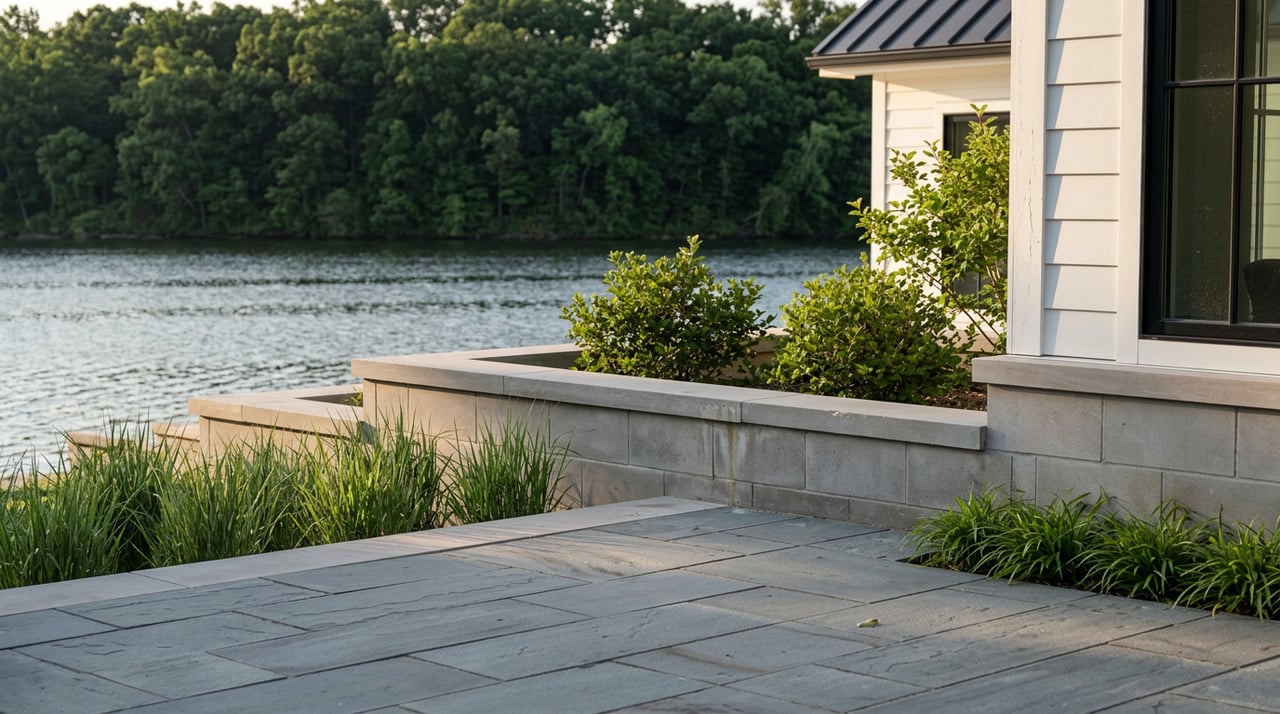
Every buyer we meet has already looked up the median. They know the Lake Minnetonka regional median sales price sat at $835,000 in October 2025, up 5.6% month over month and 13.9% over the trailing twelve months. Then they tour a renovated three bedroom on Wayzata Bay and a similarly sized cottage two bays west, and the prices are nowhere near each other. The median did not lie. It just answered a different question than the one they were asking.
Here is the friction that surfaces the moment an offer gets drafted: on this lake, frontage does not automatically come with a dock. The Lake Minnetonka Conservation District governs what you can actually put in the water in front of your house, and its math, not your square footage, sets the ceiling on value. A buyer who understands that reads listings differently than one who does not.
The three tiers of "on the water" are three different markets
The phrase "waterfront" hides a pricing spread that can double or halve a comp before anyone talks about the kitchen. Broadly, homes fall into three categories, each with its own buyer pool and its own comp set.
| Tier | What you actually own | Dock reality | Where the price lives |
|---|---|---|---|
| True lakefront | Property line meets the water; riparian rights attach | Right to apply for a dock under LMCD rules, subject to lot width and setbacks | Highest per-foot pricing; comps must come from the same bay |
| Deeded access / shared dock | No frontage; association or subdivision holds the shoreline | Slip or dock rights via the association, often with a waitlist | Priced meaningfully below true frontage while preserving lifestyle |
| Lakeshore-adjacent | Channel, back-lot, or short-walk parcels with views | No riparian rights; access depends on public ramps or neighbors | Priced closest to inland comps, with a view premium |
A listing that says "lake access" without specifying which tier is doing a lot of work with one phrase. On Lake Minnetonka, "on the water" can mean very different things and the price gap is large. True lakefront means your property line meets the water, you own shoreline, can apply for a dock under LMCD rules, and hold riparian rights. Deeded access means your association or subdivision owns the frontage, so you get dock or slip rights without the full lakefront price. Lakeshore-adjacent covers channel, bay, or back-lot properties with water views or a short walk to access, priced below true frontage. The moment you sort a search that way, the "median" loses most of its meaning.
Bay identity outranks square footage
Even inside the true-lakefront tier, the lake behaves like fourteen small markets stitched together. Lake Minnetonka spans 14,500 acres with 20 bridges and 125 miles of shoreline, and each bay has its own depth, exposure, boat traffic, and prestige signature. That is why our team prices to the micro-basin first and adjusts outward, not the other way around.
A few examples from current inventory and recent comps. Wayzata Bay and Browns Bay carry the north-shore premium tied to walkability into downtown Wayzata, which is why Bushaway Road and the Ferndale Road South "Gold Coast" continue to set the per-foot ceiling. Crystal Bay in Orono is a different product entirely: with a maximum depth of 113 feet, it is the deepest point in the entire lake system, significantly deeper than the lake's 30-foot average, and its "A" water quality rating places it among the top 10% of Lake Minnetonka's cleanest water. Buyers who prioritize water quality and deep-water dock capacity pay for that specifically.
Then there are the scarcity plays. Properties on Peavy Lake are among the most valuable on Lake Minnetonka, with an average home price around $2.7 million, thanks to unusual depth up to 63 feet in a secluded setting and very few homes with access to that waterfront, creating scarcity that further drives values. A buyer comparing Peavy against a Wayzata Bay list price on square footage alone will misread both. On the west end, Halsted's and Cooks Bays tend to offer the most attainable true-frontage entry points, which matters for buyers who care more about owning shoreline than about walking to a restaurant.
The LMCD math that quietly reprices your frontage
This is where most out-of-market buyers get surprised. Owning shoreline is not the same as being allowed to store boats on it. The LMCD follows the 1:50 feet Rule, allowing homeowners to store one watercraft per 50 feet of continuous shoreline. The Rule allows up to two watercraft for sites existing before August 30, 1978, or four watercraft for sites after, regardless of ownership. A 60-foot frontage lot and a 120-foot frontage lot are not two-thirds apart in usable value; they are on different sides of a hard line.
Layer on the newer on-water rules. The LMCD has been working closely with the Hennepin County Sheriff's Water Patrol since the passage of a 2023 rule that requires all watercraft to maintain a minimum distance of 300 feet from all shorelines and 150 feet from all structures, parked watercraft and swimmers. That was an increase from the previous 150-foot buffer, and along with the 300-foot rule, the LMCD has passed a new watercraft speed limit of 5 mph for all watercraft within 300 feet of the shore. If you were counting on wake-intensive activity directly off your own dock in a narrow bay, that assumption needs to be checked against the water in front of the specific parcel.
Municipal overlays matter too. In Orono, for instance, homeowners are not permitted to lease dock slips on their property under the city's Code Section 94-71. That is a bright-line rule with real consequences for anyone who thought an extra slip could offset carrying costs. In Mound, the picture flips: Common Land is dedicated for use in its municipal dock program, which permits up to 637 boats annually on Lake Minnetonka, using linear accessways set aside by developers between 1906 and 1921 that allow inland Mound municipal boat slip holders to dock on the direct lakeshore around Mound. That is why an inland Mound address can carry surprising lake value while an Orono lakefront cannot generate slip income.
What the 2026 numbers actually say when you read them by bay
The topline numbers are strong across the board, but strength is not uniform. New listings were up 2.8% month over month and 9.9% over the rolling twelve months, closed sales rose 11.8% in October, median sales price jumped to $835,000, average price climbed 22.6% driven by continued strength in the luxury segment, days on market lengthened from 66 to 75, and months of supply moved from 3.6 to 3.8, still well below a balanced market of 5 to 6 months.
Read that carefully. The average outran the median by a wide margin, which is the statistical fingerprint of the top of the market pulling harder than the middle. As of spring 2026, the average asking price for active waterfront listings was approximately $2.84 million at $545 per square foot, while the 2025 full-year average sales price reached $1,079,770 across the broader transacted market, reflecting the wide range between entry-level lake-access homes and ultra-luxury estates. Translation: if you are shopping the $1M to $2M waterfront band, you are in the most crowded, most competitive tier, and you will feel it. If you are shopping above $5M, you are in a thinner market where bay identity and shoreline quality are doing almost all the work.
Due diligence that protects the price you pay
Before you write, we verify four things on any true-frontage parcel. First, the shoreline measurement itself. The LMCD measures shoreline at the Ordinary High Water Level, which is the standard reference on Lake Minnetonka. A listing that quotes frontage from a plat drawing without OHWL confirmation is quoting a number you cannot rely on.
Second, dock status. Existing docks may be legal, licensed, or nonconforming, and grandfathered rights can override current rules but do not always transfer cleanly. Third, the shoreline itself. Retaining walls, riprap, seawalls, and older docks age, and replacement costs are real. Fourth, septic. Even where local rules do not require a seller inspection, many lenders want a current septic compliance inspection and a valid Certificate of Compliance before closing. These are not deal killers. They are line items that belong in the price conversation, not the surprise pile at inspection.
Frequently asked questions
Does owning lakefront guarantee I can build a dock? No. Docks are regulated. The Lake Minnetonka Conservation District controls dock length, slip count, and boat storage. Frontage gives you the right to apply, not an automatic dock, especially on smaller lots. Confirm eligibility before making an offer.
Why is bay-level pricing so much more useful than a citywide median? Because depth, exposure, boat traffic, and walkability change dramatically across the 125 miles of shoreline. A three-bedroom on Wayzata Bay and a three-bedroom on Excelsior Bay can share square footage and sell for very different numbers. Comps have to come from the same micro-basin first.
Is now a seller's market or a buyer's market on the lake? It has been a seller's market for several years, with months of supply consistently below the 5-to-6-month balanced-market threshold and sellers receiving an average of 95.5% of asking price in the most recent readings. Longer days on market at the top end signal buyer selectivity, not weakening demand.
If you are weighing bays, tiers, or a specific parcel and want the numbers read against the actual shoreline in front of it, Polovitz Group will sit down with you, pull the micro-basin comps, and walk the LMCD math before you write. Start your lake-home search or market your property with our team.